Reagan Bush Make America Great Again
| Ronald Reagan for President 1980 | |
|---|---|
| | |
| Campaign | 1980 Republican primaries 1980 U.S. presidential election |
| Candidate | Ronald Reagan 33rd Governor of California (1967–1975) George H. W. Bush 11th Director of Central Intelligence (1976–1977) |
| Affiliation | Republican Party |
| Status | Announced: November thirteen, 1979 Presumptive nominee: May 24, 1980 Official nominee: July 17, 1980 Won election: November iv, 1980 Inaugurated: January 20, 1981 |
| Fundamental people | William J. Casey (Director) Edwin Meese III (Primary of Staff) Richard Wirthlin (Pollster) Richard V. Allen (Foreign Policy Adviser) |
| Slogan | Let's Make America Great Over again Are You Amend Off Than You Were Four Years Ago? The Time Is Now for Strong Leadership[1] |

The 1980 presidential campaign of Ronald Reagan, was formally launched on Nov 13, 1979. Ronald Reagan and George H. Due west. Bush were elected president and vice president of the United States. They defeated the incumbent Democratic President Jimmy Carter and Vice President Walter Mondale. Reagan, a Republican and former governor of California, announced his third presidential bid in a nationally televised speech from New York City. He campaigned extensively for the primaries later losing the Iowa caucus to Bush-league. In the primaries, he won 44 states and 59.8% of the vote. He decided initially to nominate onetime president Gerald Ford every bit his running mate, but Ford wanted such extended powers as vice president (particularly over the foreign policy) that their ticket would finer amount to a "co-presidency". As a issue, negotiations to form a Reagan–Ford ticket ceased. Reagan then selected former Congressman and Director of the Central Intelligence Agency George H. W. Bush as his vice-presidential running mate.
At the 1980 Republican National Convention, Reagan garnered the required delegates to be the official nominee. With Carter's declining approval ratings and popularity, Ted Kennedy challenged him at the Democratic primaries, but Carter was re-nominated. John B. Anderson, who was a presidential candidate for the Republican party, left the party and entered the race as an independent candidate. On July 19, Reagan opened his campaign with a tumultuous rally in Texas with Bush. There he proclaimed the campaign slogan, "We can make America great again." He called for a drastic cut in "big government" and pledged to evangelize a counterbalanced budget for the outset fourth dimension since 1969. At a rally in New York on August five, Reagan proposed a youth differential in the minimum wage police force, for encouraging businesses to rent unskilled and unemployed blackness youths. Appealing to black voters, he said, "What I want for America is ... pretty much what the overwhelming bulk of black Americans also desire."
Two presidential debates were conducted, only Carter refused to take office if Anderson was included, so the kickoff debate was between only Reagan and Anderson. A calendar week before election day, another debate was organized between President Carter and Reagan; Anderson was not invited. On ballot twenty-four hour period, Ronald Reagan won the ballot past a landslide winning 51% percent of the popular vote with 489 electoral votes to Carter's 49 balloter votes. At 69 years former, Reagan was then the oldest non-incumbent presidential candidate to win a presidential election. President Carter hosted him in the White Firm on November 20, 1980. He was inaugurated on January 20, 1981.
Background [edit]

Ronald Reagan was born in Tampico, Illinois, in 1911.[2] Subsequently graduating from Eureka Higher in 1932, he worked every bit a radio commentator and later became a Hollywood movie actor and matrimony leader.[3] Initially a Democrat, he became a Republican in 1962.[4] While endorsing the Republican presidential nominee Barry Goldwater, he gave his famous "A Time for Choosing" speech, which earned him national attention as a new conservative spokesman.[v] In late 1965, he announced his campaign for governor of California in the 1966 gubernatorial election.[6] He won the election, becoming the 33rd governor of California. He was a presidential candidate in the 1968 Republican presidential primaries, simply lost to sometime vice president Richard Nixon in the delegate count, despite winning the popular vote.[7] He was re-elected as governor in 1970 with virtually 53% of the vote.[8]
Subsequently leaving role in 1975, he began his 1976 presidential campaign against the incumbent President Gerald Ford.[9] They were cervix and neck in the primaries, but in the end, Ford won more primary delegates than Reagan, but he did not have enough (1,130) delegates to secure the nomination. Both campaigns relied on votes from un-pledged delegates to secure the nomination.[ten] Before long earlier the 1976 Republican National Convention, Reagan announced Senator Richard Schweiker as his running mate, hoping to pry loose some delegates from Schweiker's home state of Pennsylvania. Although Ford ultimately won the nomination, it showed Reagan could accept risks with a running mate selection.[eleven] Ford won the nomination with 1,187 delegates to Reagan'due south 1,070. He considered Reagan as his possible running mate, only later on Reagan told a conclave of the Kansas delegation that he would not accept the vice-presidential nomination, Ford selected Bob Dole.[12] Ford later lost the election to Democratic nominee Jimmy Carter.[13] Reagan received an balloter higher vote by a faithless elector from Washington.[xiv]
Gaining the nomination [edit]
Preparing for a run [edit]
On November xiii, 1979, Reagan appear his third presidential bid in a nationally televised speech from New York City,[xv] the tenth Republican to do so.[16] His entrada capitalized on his acting skills, showing Reagan speaking in a presidential-looking room.[17] During the speech, he never direct mentioned President Carter merely called the current assistants'southward free energy policies an "utter fiasco" and blamed regime spending and deficits for high inflation.[eighteen] He borrowed the phrase "rendezvous with destiny" from Franklin D. Roosevelt's 1936 acceptance voice communication.[19] He said:
We, today'southward living Americans have in our lifetime fought harder, paid a higher price for freedom and done more to advance the dignity of human being than any people who have ever lived on this Earth. The citizens of this great nation want leadership, aye simply non a "homo on a white horse" demanding obedience to his commands. They want someone who believes they tin can "begin the globe over again." A leader who will unleash their great strength and remove the roadblocks authorities has put in their way. I desire to do that more than anything I've e'er wanted. And it's something that I believe with God's help I can do.[20]

Reagan'southward Republican primaries campaign logo.
In a press conference the aforementioned day, Reagan named a young representative, Jack Kemp, equally one of his principal campaign spokespersons. This probable helped him annul the outcome of his age.[21] After the speech, Reagan went on a five-day campaign trip to visit 12 cities. He repeated his 1976 proposal to shift some functions of government abroad from Washington, simply his press secretary, James Lake, said that, dissimilar the before version, the new proposal was full general and did not spell out programs that would be transferred.[22] He was the front-runner candidate when he announced his campaign.[23]
Republican presidential primaries [edit]
The primary elections and caucuses were held for all l states and the Washington, D.C. from Jan 21 to June iii, 1980. In addition to Reagan, the major candidates were George H. W. Bush-league, John Anderson, Howard Baker, John Connally, and Bob Dole.[24] There was speculation nearly the potential candidacy of erstwhile President Gerald Ford, just he declined to run against Reagan.[25] In an upset defeat in the Iowa caucus held on Jan 21, Reagan narrowly lost to Bush.[26] After the win, Bush-league said his campaign was full of momentum, or "the Big Mo", and they would perform even ameliorate in the New Hampshire primary.[27] [28]
Three days before the New Hampshire primary, the Reagan and Bush campaigns agreed to a one-on-one debate sponsored by The Telegraph at Nashua, New Hampshire, only hours before the fence, the Reagan campaign invited other candidates including Dole, Anderson, Baker and Phil Crane.[29] Argue moderator John Breen denied seats to the other candidates, asserting that The Telegraph would violate federal campaign contribution laws if it sponsored the debate and changed the ground rules hours earlier the fence.[thirty] As a result, the Reagan campaign agreed to pay for the debate. Reagan said that as he was footing the bills, he could decide who would contend.[31] During the debate, when Breen was laying out the ground rules, Reagan interrupted in protest to make an introductory statement and wanted other candidates to be included.[32] The moderator asked for Reagan's microphone to exist turned off. Reagan furiously replied, "I am paying for this microphone, Mr. Light-green! [sic]".[a] [34] This turned out to be the turning point of the argue and the principal campaign.[35] Ultimately, the four boosted candidates left, and the contend continued betwixt Reagan and Bush-league. Reagan's polling numbers improved, and he won the New Hampshire chief by more than 39,000 votes.[36]

Republican Debate with Philip Crane, George H. Westward. Bush, moderator Eric Sevareid, Ronald Reagan, and John B. Anderson in Chicago, Illinois
Bush defeated Anderson and won the Massachusetts primary with a margin of 0.34%, although both received equal numbers of delegates.[37] With the Due south Carolina chief approaching, political operative Lee Atwater leaked a story to Lee Bandy, a writer for The Land newspaper that John Connally had tried to buy the blackness vote, which nearly destroyed Conally'south campaign.[38] Reagan swept to victory in South Carolina, defeating Connally by fourteen%.[39] The next day, Connally formally withdrew from the campaign and endorsed Reagan.[40] With the Illinois chief budgeted, the League of Women Voters sponsored a argue between Reagan, Bush, Anderson, and Crane. The candidates criticized Anderson for signing a fund-raising letterseeking supports for liberal Democratic senators, and Reagan questioned whether Anderson was really running as a Republican.[41] Reagan won the Illinois primary with 48% of the votes to Anderson'due south 37%.[42]
Reagan continued to win many other primaries and caucuses, although Bush-league won states like Connecticut, Maine, Pennsylvania, and Michigan.[43] Afterwards the Pennsylvania main, Anderson withdrew from the Republican race and re-entered the race as an independent candidate.[44] On May 20, 1980, after the Michigan and Oregon primaries, Reagan secured enough delegates to clinch the nomination for the Republican Party.[45] Reagan said he would always be grateful to the people of Iowa for giving him "the kicking in the pants" he needed.[46] On May 26, Bush-league; Reagan'due south remaining opponent for the Republican nomination conceded defeat and urged his supporters to support Reagan.[47] On June 3 (Super Tuesday), Reagan won all nine primaries.[48] With the end of the primaries, Reagan had won 59.8% votes to Bush-league'due south 23.8% and Anderson'due south 12.2%.[24]
Republican National Convention [edit]

Reagan giving his acceptance spoken communication at the Republican National Convention.
With the Republican National Convention approaching, Reagan prepared to select his running mate. Columnist Jack Germond and Jules Witcover wrote in their book Bluish Fume & Mirrors that Reagan's vice-presidential selection began as early every bit May 1980.[49] His choice for vice presidential running mate included former president Gerald Ford, who revealed it in a CBS interview with Walter Cronkite,[50] saying he was seriously considering the vice presidency. In late May and early June, Dick Wirthlin conducted polls showing that in each category tested Ford rated ahead of all other Republicans existence mentioned as possible running mates.[fifty] Ford'southward representatives in these negotiations reportedly included Henry Kissinger, Alan Greenspan, and Dick Cheney, who had been Ford's White House chief of staff.[25]
Yet, after Ford suggested the possibility of a "co-presidency" and also insisted that Kissinger be re-appointed as Secretarial assistant of State with Alan Greenspan exist appointed as Secretary of the Treasury, negotiations to form a Reagan-Ford ticket ceased.[51] Reagan'south other prospects were Bush, Howard Baker, William Simon, Donald Rumsfeld, Richard Lugar, Jack Kemp, Guy Vander Jagt, and Paul Laxalt.[52] Less than twenty-iv hours earlier Reagan had formally accustomed the Republican nomination, he telephoned Bush-league to inform him of his intention to nominate him. On the following day, July 17, the final day of the Republican National Convention, Reagan officially announced Bush-league as his running mate.[53]
The 1980 Republican National Convention convened at Joe Louis Loonshit in Detroit, Michigan.[53] Some notable speakers included Guy Vander Jagt, former treasury secretary William E. Simon, former defense force secretary Donald Rumsfeld and former president Gerald Ford. In the whorl telephone call vote, Reagan received 1,939 delegates to Anderson'south 37 and Bush's 13. Anne Armstrong received one vote.[54] Bush was nominated every bit the vice-presidential candidate. Reagan accepted the Republican nomination on the final day of the convention. He said:
With a deep awareness of the responsibility conferred past your trust, I accept your nomination for the presidency of the U.s.. I practise so with deep gratitude, and I call back also I might interject on behalf of all of us, our thanks to Detroit and the people of Michigan and to this city for the warm hospitality they have shown. And I thank y'all for your wholehearted response to my recommendation in regard to George Bush-league every bit a candidate for vice president.[55]
Opponents [edit]
Jimmy Carter'due south first term began with a loftier approving rating reaching 66%, but information technology soon began to autumn; his lowest approval rating was 28%.[56] This likely helped other Democrats like Massachusetts senator Ted Kennedy (Quondam President John F. Kennedy's blood brother), and Governor Jerry Brown seek the nomination against an incumbent president in the Democratic presidential primaries. Kennedy launched his campaign in late 1979.[57] Momentum built for Kennedy after the attempt to rescue 52 embassy staff held captive at the Embassy of the United States in Tehran on April 25 ended in disaster and increased skepticism of Carter'southward leadership ability.[58] Although Carter won 32 land primaries including the early states similar Iowa and New Hampshire, Kennedy's 12 victories included some crucial states similar Massachusetts, New York and California.[59] Kennedy did non concede to Carter until August xi, 1980, at the Democratic National Convention in New York City.[lx]
Anderson was a presidential candidate from the Republican party, just after the Pennsylvania primary, he withdrew from the race and re-entered information technology as an independent candidate.[44] In a 1992 interview, he recalled the biggest obstacle he faced as an independent candidate was having to authorize for election admission in 50 states and the District of Columbia.[61] He selected Governor Patrick Lucey equally his running mate.[62] In April 1980, he was polling at 21%, which was relatively high for an independent candidate. This remained constant, with little fluctuation, until late July 1980, after which his ratings began to drop.[63] Anderson received endorsements from various newspapers including the Minneapolis Star Tribune, The Boston Globe,[64] the Hartford Courant,[64] the San Jose Mercury News,[64] the Austin American-Statesman,[64] and Florida's largest paper the Miami Herald.[65] Most of Anderson'southward support came from Liberal Republicans who were suspicious of, or even hostile to Reagan's conservative supporters.[66] In belatedly August, he was polling merely 14%, which later continued to drop to viii per centum only before election twenty-four hours.[67]
Entrada [edit]
Initial developments [edit]

Reagan remembered that Franklin D. Roosevelt won the 1932 presidential election because he successfully proved he was not Herbert Hoover. Reagan guessed he would similarly do good from not beingness Jimmy Carter.[68] He began his entrada with a tumultuous rally in Texas on July 19 with Bush, where he proclaimed the campaign slogan, "We can brand America great again."[69] The Carter campaign attempted to deny the Reagan campaign $29.four meg (equivalent to $92,344,023 in 2020) in federal entrada funds, the legal limit for campaign spending.[lxx] They claimed he was ineligible for the greenbacks every bit contained groups with well-known Republican members had donated upward to $60 million (equivalent to $188,457,189 in 2020) for Reagan'southward campaign. The Federal Election Commission unanimously rejected the plea and approved the payment.[lxx] At the same fourth dimension, belatedly July, President Carter's blood brother, Billy Carter, was existence investigated for receiving funds from Libya.[71] In late June and in July, Reagan began to pb Carter in polls. In early on August, his atomic number 82 polling numbers reached 45% to Carter's 39% and Anderson's xiv%.[67] On July 30, 1980, a Senate committee concluded that Billy had lied to justice examiners,[72] just ultimately found no evidence that he had influenced American policy.[73]
Reagan promised a restoration of the nation'south armed forces strength at a time when lx% of Americans polled felt defense spending was too low.[74] Reagan also promised an end to "trust me government", and to restore economic wellness by implementing a supply-side economic policy. At a rally in New York on Baronial 5, Reagan proposed a youth differential in the minimum wage law to encourage businesses to hire unskilled and unemployed blackness youths. Appealing to blackness voters, he said, "What I want for America is, I retrieve, pretty much what the overwhelming majority of black Americans also desire."[75] The 1980 entrada has been used every bit an example of dog-whistle rhetoric by some. While giving a spoken communication at the Neshoba Canton Fair in early Baronial, Reagan used the term "state's rights", and too referred to "Cadillac-driving welfare queens" and "strapping young bucks buying T-os steaks with nutrient stamps".[76] Some too saw these deportment as an extension of a "Southern Strategy" developed past President Richard Nixon to garner white support for Republican candidates.[77] Reagan's supporters take pointed out their belief that this was his typical anti-large regime rhetoric, with no racial context or intent.[78] David Brooks later on noted the fact that Reagan had been courting blackness voters at the same fourth dimension he was supposedly using this code language.[79] Reagan himself always denied he was a racist or was insensitive to the plight of the poor, writing that: "I was raised by a mother and father who instilled in me and my brother a hatred for bigotry and prejudice... we were poor in an era where there were no regime programs to plow to."[80]
| Campaign commercials | |
|---|---|
 Presidential Campaign Commercials 1980 – C-SPAN Presidential Campaign Commercials 1980 – C-SPAN |
Advertising his campaign was crucial for Reagan. Polls showed that virtually 40% of the voters knew very little most him or what he stood for.[81] He campaigned extensively, and his political advertisements were broadcast on diverse television channels.[82] Reagan was an adherent of supply-side economics, which argues that economic growth tin can exist about effectively created using incentives for people to produce (supply) goods and services, such as adjusting income revenue enhancement and capital gains tax rates.[83] Accordingly, Reagan promised an economic revival that would touch on all sectors of the population.[83]
Rallies and debates; the final days [edit]
Contend between Ronald Reagan and John Anderson on September 21, 1980
Reagan called for a drastic cut in "large authorities" and pledged to deliver a balanced budget.[84] In the primaries, Bush-league famously called Reagan's economical policy "voodoo economics" because it promised to lower taxes and increase revenues at the same time. In his entrada speeches, Reagan presented his economic proposals as a return to free enterprise principles, a gratis market economy that had been in favor earlier the Great Depression and Franklin Roosevelt's New Deal policies.[85] At the same fourth dimension, he attracted a following from the supply-side economics movement, which formed in opposition to Keynesian demand-stimulus economic science. This movement produced some of the strongest Reagan supporters of the entrada.[85]
The League of Women Voters appear they would sponsor three presidential debates and 1 vice presidential debate.[86] They specified John Anderson would be included if he attained an boilerplate of fifteen% support in the major national opinion polls.[87] Carter and his advisers were adamant in their refusal to allow Anderson to accept part. Although the poll figures were ambiguous, they seemed to suggest that Anderson would cut more than deeply into Carter's votes than into Reagan's.[87] Carter's campaign went through the motions of sending a squad of negotiators led past Bob Strauss to discuss the debate, just the bottom line remained that there would be no three-mode debate. "We just can't do information technology," Strauss said. "Whatever it costs, nosotros'll have to take it."[88]
- Chicago Tribune in Chicago, Illinois[89]
- New York Mail in New York Metropolis[90]
- Albany Democrat-Herald in Albany, Oregon[ninety]
- San Diego Union Tribune in San Diego, California[91]
- Norfolk Virginian-Pilot in Norfolk, Virginia[92]
- The Detroit News in Detroit, Michigan[93]
- San Antonio Limited-News in San Antonio, Texas[94]
- K Rapids Printing in Grand Rapids, Michigan[95]
- The Telegraph in Alton, Illinois[89]
- El Paso Times in El Paso, Texas[90]
- Ada Evening News in Ada, Oklahoma[90]
- The Apparently Dealer in Cleveland, Ohio[96]
- Alexandria Gazette in Alexandria, Virginia[90]
- Atlantic News-Telegraph in Atlantic, Iowa[89]
- Farmington Daily Times in Farmington, New Mexico[89]
Meanwhile, the Reagan campaign refused to debate without Carter, while Anderson himself said, "As far as I'm concerned, any debate is improve than no argue."[97] Subsequently months of negotiations, the league held a argue between Reagan and Anderson, equally Carter still refused to participate.[98] On September 21, 1980, Reagan and Anderson participated in a presidential fence moderated by Bill Moyers in Maryland. During the debate, Anderson started by criticizing Carter and maxim, "Governor Reagan is not responsible for what has happened over the last four years, nor am I. The man who should be here tonight to answer to those charges chose non to attend."[99] Reagan added: "It's a shame now that there are but two of us here debating, because the two that are hither are in more agreement than disagreement."[100] Reagan repeated his pledge to residual the federal budget, proverb he believed that "the budget can be counterbalanced by 1982 or 1983".[b] [101]
Both candidates strongly disagreed on ballgame, with Reagan memorably proverb, "I've noticed that everyone who is for ballgame has already been born."[102] In the kickoff mail-debate survey past ABC–Harris, 36% of the viewers thought Anderson had performed better, 30% favored Reagan and 17% thought they were equally effective.[103] CBS took a survey just before the debate; the results were Carter 40%, Reagan 36%, and Anderson 9 percent. Only later on the contend, its poll found Reagan at 40%, Carter at 35%, and Anderson unchanged at ix per centum. On October 14, Wirthlin ended from his polls that Carter had moved alee of Ronald Reagan past ii percent for the beginning time. Reagan himself sensed that his bid for the presidency now seemed to be winding downwards.[104] While traveling during his entrada in South Dakota, Reagan told his press secretary Lyn Nofziger, "I think it's about time we consider a debate."[104]
3 weeks before the election, Yankelovich, Skelly and White produced a survey of 1,632 registered voters showing the race nigh dead even, as did a individual survey by Caddell.[105] Two weeks afterwards, a survey by CBS News and The New York Times showed a similar situation.[105] Although some pollsters reported a slight Reagan lead, ABC–Harris surveys consistently gave Reagan a atomic number 82 of a few points until the last calendar week of October. Thereafter, Reagan trailed Carter in about polls. In the Gallup poll on Oct 26, Jimmy Carter was at 47% and Ronald Reagan at 39%.[106] On Oct 31, Reagan campaigned in four states – Pennsylvania, Illinois, Wisconsin, and Michigan, which were properly considered "battleground" states.[107]
Fence betwixt Ronald Reagan and Jimmy Carter on October 28, 1980.
A week earlier election day, the League of Women Voters organized a debate between President Carter and Reagan. John Anderson was not invited because his polling numbers were beneath 15%.[108] Howard K. Smith moderated the debate, and the showdown resulted in among the highest ratings of any tv plan in the previous decade.[109] Debate topics included the Iranian hostage crunch, and nuclear arms treaties and proliferation. As the debate continued, Carter repeatedly pressed Reagan to explain his earlier statements opposing Social Security.[110] When Carter accurately pointed out that Reagan "began his career campaigning around this nation against Medicare," Reagan looked over at him and said, "There you go once again" intending to disarm Carter.[111] It emerged as the defining moment of the 1980 presidential election.[112] [113]
In his closing remarks, Reagan asked viewers:
Are yous better off now than you were four years ago? Is it easier for you to go and buy things in the stores than it was four years ago? Is there more or less unemployment in the country than there was four years agone? Is America every bit respected throughout the world every bit it was? Practise you experience that our security is every bit safe, that we're as strong as we were four years ago? And if yous answer all of those questions 'yes', why then, I think your selection is very obvious as to whom you will vote for. If you don't concord, if you don't think that this grade that nosotros've been on for the concluding four years is what you would similar to come across us follow for the next four, so I could propose another choice that you have.[114]
CNN attempted to include Anderson in the contend from the Constitution Hall in Washington, D.C. CNN's Daniel Schorr read the same questions to Anderson. They then aired Anderson's live responses along with a tape filibuster of Carter and Reagan's responses,[115] [116] despite technical difficulties.[117] Following his solo debate with President Carter on Oct 28, Reagan overcame the largest deficit since Gallup polling began in 1936.[118] Within one week, the Associated Printing reported that the race was "too close to telephone call". No vice presidential debates were conducted. It was later discovered that the Reagan campaign had somehow caused President Carter's briefing papers, classified top secret.[119]
In his Ballot Eve Address "A Vision for America" a day before the election day, Reagan said:
I have quoted John Winthrop's words more than one time on the campaign trail this year—for I believe that Americans in 1980 are every bit as committed to that vision of a shining city on a hill, as were those long agone settlers ... These visitors to that city on the Potomac practise non come equally white or blackness, red or yellow; they are not Jews or Christians; conservatives or liberals; or Democrats or Republicans. They are Americans awed by what has gone before, proud of what for them is still... a shining metropolis on a hill.[120]
Election 24-hour interval [edit]

1980 electoral college vote

NBC news projects Reagan wins the 1980 election at 08:15 p.m. EST.
On Nov 4, Ronald Reagan and George H. Westward. Bush-league defeated Jimmy Carter and Walter Mondale in a landslide victory.[121] Reagan received 489 electoral votes to Carter's 49; the popular vote was approximately 51% to 41%.[122] Reagan won every state except Georgia (Carter's home country), Maryland, Minnesota (Mondale's habitation state), Hawaii, West Virginia, Rhode Island, and the District of Columbia.[122] John Anderson won 6.six% of the popular vote but won no state outright.[122] Republicans also gained control of the Senate on Reagan'due south coattails for the commencement time since 1952.[123]
Carter's loss was the worst functioning by an incumbent president since Herbert Hoover lost to Franklin D. Roosevelt past a margin of 18% in 1932, and his 49 electoral college votes were the fewest won past an incumbent since William Howard Taft won just viii in 1912. At 69 years one-time, Ronald Reagan was the oldest non-incumbent presidential candidate to win a presidential election. Thirty-six years later, in 2016, this record was surpassed by Donald Trump at 70 years erstwhile. It was surpassed once more by Joe Biden who was elected at 77 years quondam in 2020.[124] Jimmy Carter conceded to Reagan and said:
The people of the United States take made their choice, and, of course, I take that decision merely, I have to admit, not with the aforementioned enthusiasm that I accustomed the decision 4 years ago. I have a deep appreciation of the arrangement, nevertheless, that lets people make the free option almost who will lead them for the side by side 4 years. About an hour ago I called Governor Reagan in California, and I told him that I congratulated him for a fine victory. I look forrad to working closely with him during the next few weeks.[125]
Results [edit]
| Presidential candidate | Party | Domicile state | Popular vote | Electoral vote | Running mate | |||
|---|---|---|---|---|---|---|---|---|
| Count | Percentage | Vice-presidential candidate | Home state | Electoral vote | ||||
| Ronald Wilson Reagan | Republican | California | 43,903,230 | 50.75% | 489 | George Herbert Walker Bush | Texas | 489 |
| James Earl Carter, Jr. (incumbent) | Autonomous | Georgia | 35,480,115 | 41.01% | 49 | Walter Frederick Mondale | Minnesota | 49 |
| John Bayard Anderson | Independent | Illinois | five,719,850 | 6.61% | 0 | Patrick Joseph Lucey | Wisconsin | 0 |
| Edward East. Clark | Libertarian | California | 921,128 | 1.06% | 0 | David Hamilton Koch | Kansas | 0 |
| Barry Commoner | Citizens | Missouri | 233,052 | 0.27% | 0 | LaDonna Vita Tabbytite Harris | Oklahoma | 0 |
| Gus Hall | Communist | New York | 44,933 | 0.05% | 0 | Angela Yvonne Davis | California | 0 |
| John Richard Rarick | American Independent | Louisiana | 40,906 | 0.05% | 0 | Eileen Shearer | California | 0 |
| Clifton DeBerry | Socialist Workers | California | 38,738 | 0.04% | 0 | Matilde Zimmermann | New York | 0 |
| Ellen Cullen McCormack | Right to Life | New York | 32,320 | 0.04% | 0 | Carroll Driscoll | New Jersey | 0 |
| Maureen Smith | Peace and Freedom | California | 18,116 | 0.02% | 0 | Elizabeth Cervantes Barron | California | 0 |
| Other | 77,290 | 0.09% | — | Other | — | |||
| Full | 86,509,678 | 100% | 538 | 538 | ||||
| Needed to win | 270 | 270 | ||||||
- Source (popular vote): Leip, David. "1980 Presidential Election Results". Dave Leip's Atlas of U.Due south. Presidential Elections . Retrieved August 7, 2005.
- Source (electoral vote): "Electoral College Box Scores 1789–1996". National Athenaeum and Records Administration. Retrieved August 7, 2005.
Aftermath and legacy [edit]
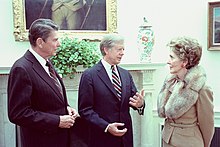
After his defeat in the election, President Carter proclaimed his desire for a shine transition between his approachable and the incoming administrations. The Reagan transition team was led by Edwin Meese and was headquartered in Washington, D.C.[126] The transition team worked closely with bourgeois organizations such as the Heritage Foundation, the American Enterprise Institute, and the Hoover Institution, which provided the Reagan transition team with extensive plans for the new administration.[127] President Carter hosted Reagan at the White House on November 20, two months before his inauguration.[128]
Reagan was inaugurated on January 20, 1981. Afterward, information technology was discovered that the Reagan entrada had caused President Carter'due south briefing documents.[119] This leak of campaign papers was not divulged to the public until belatedly June 1983. Carter said that he remained "completely aloof" from the investigation inside the Reagan administration,[129] while Reagan claimed he had no noesis of any involvement in whatsoever transactions involving materials produced for President Carter.[130] The matter was never resolved as both the FBI and a congressional subcommittee reporting in May 1984 failed to determine how or through whom the conference volume came to the Reagan campaign.[131] The Justice Department, in closing its investigation, cited "the professed lack of retentiveness or knowledge on the part of those in possession of the documents".[132]
Reagan was re-elected in 1984 with an overwhelming majority winning every state except Minnesota and the Commune of Columbia, which were won by his opponent, Walter Mondale.[133] During his term as president, Reagan pursued policies that reflected his personal belief in individual freedom, brought economic changes, expanded the armed forces, and contributed to the cease of the Cold War.[134] Termed the "Reagan Revolution", his presidency would boost American morale,[135] reinvigorate the U.S. economic system and reduce reliance upon government.[136]
George H. Due west. Bush, his vice president, was elected as president in 1988, and became the first incumbent vice president to exist elected president since Martin Van Buren in 1836.[137] Ane of the legacies of the campaign was the auditory skills of Ronald Reagan, which earned him the title "The Great Communicator".[138] In 2008, the Associated Press wrote, "Reagan was a master at capturing a debate moment that everyone will remember. His 'at that place you go again' line defused his opponent's assault."[139] David Broder, a political reporter and columnist for The Washington Post, summed upwards the result of the Nashua debate in a campaign vocal "Joshua Fit the Battle". He wrote:
"Nashua was the battle that lost the state of war,
To Reagan and the Gang of Four."[140] [141]
The entrada slogan popularized by him – "Let's Make America Corking Again" was subsequently used past candidates such as Bill Clinton in his 1992 entrada and Donald Trump every bit "Make America Peachy Again" in his 2016 presidential campaign, each of which proved successful.[142] [143]
See as well [edit]
- Ronald Reagan 1984 presidential campaign
- 1980 Democratic National Convention
- Starting time inauguration of Ronald Reagan
Notes and references [edit]
Notes [edit]
- ^ Reagan misstated Breen's last name every bit "Mr. Light-green"[33]
- ^ In late 1981, all the same, Reagan abandoned his pledge to residuum the upkeep, maxim: "I've never said anything simply that information technology was a goal. And the eventual goal, whether information technology comes then 1984 or whether it has to be delayed or not, is a counterbalanced budget."[101]
References [edit]
- ^ "The Living Room Candidate – Commercials – 1980 – Reagan's Tape". Archived from the original on December 27, 2020. Retrieved October 21, 2018.
- ^ "Main Street Historic District, National Register of Historic Places Nomination Class" (PDF). Illinois Historic Preservation Bureau. April one, 1982. Archived from the original (PDF) on August vii, 2007. Retrieved July 27, 2007.
- ^ "Ronald Reagan". White House. Archived from the original on Oct 8, 2021. Retrieved October 9, 2021.
- ^ Cannon, Lou (October 4, 2016). "Ronald Reagan – Life Before The Presidency". Miller Center of Public Affairs. Archived from the original on August 12, 2021. Retrieved Oct nine, 2021.
- ^ "A Time for Choosing". PBS. Archived from the original on September 22, 2011. Retrieved April 17, 2007.
- ^ Anderson & Lee 1967, pp. 535–554.
- ^ Guide to U.S. Elections 2009, p. 411.
- ^ Guide to U.S. Elections 2009, p. 1603.
- ^ "Reagan Assailant Subdued, Held". Pittsburgh Post-Gazette. November 21, 1975. Archived from the original on May 21, 2021. Retrieved May 21, 2021.
- ^ Mears, Walter R. (August 19, 1976). "Ford nominated on starting time ballot". Pittsburgh Post-Gazette. Archived from the original on May 21, 2021. Retrieved May 21, 2021.
- ^ Kilgore, Ed (July 16, 2020). "Remembering the Reagan-Ford 'Co-Presidency' That Could Accept Been". Intelligencer. Archived from the original on May 23, 2021. Retrieved May 24, 2021.
- ^ "Ford heads to Nomination". Pittsburgh Post-Gazette. August xix, 1976. Archived from the original on May 21, 2021. Retrieved May 21, 2021.
- ^ Guide to U.S. Elections 2009, p. 333.
- ^ "Electoral College wasn't done deal in 1976. Will information technology be in 2016?". The Spokesman-Review. Dec 17, 2016. Archived from the original on May 24, 2021. Retrieved May 24, 2021.
- ^ "Intent to Run for President". Ronald Reagan Presidential Library. Nov xiii, 1979. Archived from the original on January 24, 2009. Retrieved Feb ii, 2009.
- ^ "Reagan opens bid, Revokes "Rendezvous with destiny"". Pittsburgh Post-Gazette. November 14, 1979. Archived from the original on May 22, 2021. Retrieved May 22, 2021.
- ^ Montanaro, Domenico (Apr 16, 2015). "Throwback Thursday: Reagan Announces Run For President". NPR. Archived from the original on August 9, 2019. Retrieved May 30, 2021.
- ^ "Reagan 10th GOP Hopeful". The Altus Times-Democrat. Nov 14, 1979. Archived from the original on May 22, 2021. Retrieved May 22, 2021.
- ^ "Reagan ends the 'exile'". Toledo Blade. Nov sixteen, 1979. Archived from the original on May 22, 2021. Retrieved May 22, 2021.
- ^ "Ronald Reagan For President 1980 Announcement". 4president. Archived from the original on April eleven, 2021. Retrieved May 22, 2021.
- ^ Kane, Frank (November fourteen, 1979). "Reagan act to nullify age as a campaign issue". Toledo Blade. Archived from the original on May 22, 2021. Retrieved May 22, 2021.
- ^ "Reagan finally joins GOP race". The San Bernardino Sun. Nov 14, 1979. Archived from the original on May 22, 2021. Retrieved May 22, 2021 – via California Digital Paper Collection.
- ^ "Rendezvous for Reagan". Pittsburgh Post-Gazette. November fifteen, 1979. Archived from the original on May 22, 2021. Retrieved May 22, 2021.
- ^ a b Guide to U.South. Elections 2009, p. 429.
- ^ a b Kilgore, Ed (July 16, 2020). "Remembering the Reagan-Ford 'Co-Presidency' That Could Take Been". The Intelligencer. Archived from the original on May 23, 2021. Retrieved May 24, 2021.
- ^ "Caucus Results" (PDF). Iowa. Archived (PDF) from the original on July 10, 2021. Retrieved July 20, 2021.
- ^ Boyd, Gerald M. (September 24, 1987). "Bush Loosens Upward In Iowa Campaign". The New York Times. Archived from the original on Nov vi, 2017. Retrieved October 9, 2021.
- ^ Beschloss, Michael R. "George Bush-league". PBS. Archived from the original on May 24, 2013. Retrieved October 9, 2021.
- ^ "GOP Debate fires tempers". San Bernardino Sunday. February 24, 1980. Archived from the original on May 22, 2021. Retrieved May 22, 2021 – via California Digital Newspaper Collection.
- ^ Birkner 1987, pp. 283–289.
- ^ "GOP flaps over rules, overshadows debate". Toledo Blade. Feb 24, 1980. Archived from the original on May 22, 2021. Retrieved May 22, 2021.
- ^ Dufresne, Louise (February 11, 2016). "Ronald Reagan's testy moment in the 1980 GOP argue". CBS News. Archived from the original on May 22, 2021. Retrieved May 22, 2021.
- ^ Marquard, Bryan (Oct two, 2017). "Jon Breen, 81, editor who moderated famous Reagan-Bush debate". The Boston Earth. Archived from the original on Oct 8, 2017. Retrieved July 20, 2021.
- ^ "RealClearSports – Ronald Reagan: "I am paying for this microphone."". RealClearPolitics. Nov 11, 2015. Archived from the original on Apr 15, 2021. Retrieved May 22, 2021.
- ^ "N.H. Campaign at fever pitch before principal". Pittsburgh Post-Gazette. Feb 25, 1980. Archived from the original on May 22, 2021. Retrieved May 22, 2021.
- ^ "Reagan scores landslide win in Hew Hampshire". Toledo Blade. February 27, 1980. Archived from the original on May 22, 2021. Retrieved May 22, 2021.
- ^ "Anderson nearly pulls of upset". The Altus Times-Democrat. March 5, 1980. Archived from the original on May 22, 2021. Retrieved May 22, 2021.
- ^ "Transcript – Boogie Human – The Lee Atwater Story". PBS. Archived from the original on October 21, 2017. Retrieved May 22, 2021.
- ^ "Reagan takes S. Carolina master, Connally'southward challenge complanate". San Bernardino Dominicus. March 9, 1980. Archived from the original on May 22, 2021. Retrieved May 22, 2021 – via California Digital Newspaper Collection.
- ^ "Connally drops out of the race, says "Reagan still champion"". Toledo Blade. March 10, 1980. Archived from the original on May 22, 2021. Retrieved May 22, 2021.
- ^ Fiensilber, Mike (March xiv, 1980). "GOP candidates debate, turns from friendly to feisty". Toledo Blade. Archived from the original on May 22, 2021. Retrieved May 22, 2021.
- ^ "Past ii–one, Reagan is victor over Anderson in Illinois". Toledo Bract. March 19, 1980. Archived from the original on May 22, 2021. Retrieved May 22, 2021.
- ^ "Bush surprises Reagan with a 2–i victory in Michigan GOP primary". Toledo Blade. May 21, 1980. Archived from the original on May 22, 2021. Retrieved May 22, 2021.
- ^ a b Jaques, Milton (April 25, 1980). "Anderson re-enters every bit an independent". Pittsburgh Post-Gazette. Archived from the original on May 22, 2021. Retrieved May 22, 2021.
- ^ Mears, Walter R. (May 21, 1980). "Bush sweeps Michigan, Reagan wins in Oregon". Pittsburgh Mail service-Gazette. Archived from the original on May 22, 2021. Retrieved May 22, 2021.
- ^ Cannon, Lou (June 1, 1980). "Reagan: Iowa Loss Allowed Him to Campaign His Style". The Washington Post. Archived from the original on May 22, 2021. Retrieved May 22, 2021.
- ^ Ciccone, F. Richard (May 27, 1980). "Bush quits, backs Reagan". Chicago Tribune. Archived from the original on October 19, 2012. Retrieved February 3, 2009.
- ^ "Primaries at a glance". Toledo Blade. June 4, 1980. Archived from the original on May 22, 2021. Retrieved May 22, 2021.
- ^ Germond & Witcover 1981, p. 166.
- ^ a b Germond & Witcover 1981, p. 167.
- ^ Kilgore, Ed (July sixteen, 2020). "Remembering the Reagan-Ford 'Co-Presidency' That Could Have Been". The Intelligencer. Archived from the original on May 23, 2021. Retrieved May 23, 2021.
- ^ Schram, Martin (July ten, 1980). "Reagan Would Rather Go Information technology Alone, but Cull He Must". The Washington Mail service. Archived from the original on Baronial 28, 2017. Retrieved July 20, 2021.
- ^ a b Drew, Elizabeth. "1980: The Republican Convention". The New Yorker. Archived from the original on May 24, 2021. Retrieved May 24, 2021.
- ^ Guide to U.S. Elections 2009, p. 735.
- ^ "American Rhetoric: Ronald Reagan – 1980 Republican National Convention Accost". American Rhetoric. Archived from the original on May 24, 2021. Retrieved May 24, 2021.
- ^ "Presidential Chore Approval Centre". Gallup. Archived from the original on March 23, 2021. Retrieved May 24, 2021.
- ^ "Kennedy Presidential committee formed". Toledo Blade. October 30, 1979. Archived from the original on May 24, 1979. Retrieved May 24, 2021.
- ^ Rose 2001, pp. 45–48.
- ^ Safire, William (July 31, 1978). "Report From 1980". The New York Times. Archived from the original on May 24, 2021. Retrieved May 24, 2021.
- ^ Ward, Jon (January 21, 2019). "The Humiliating Handshake and the Near-Fistfight that Broke the Autonomous Party". Politico. Archived from the original on Feb 11, 2021. Retrieved July xx, 2021.
- ^ "Running for President as an Independent". C-SPAN. Archived from the original on May 25, 2021. Retrieved May 25, 2021.
- ^ Fitzsimmons, Emma G. (May 12, 2014). "Patrick J. Lucey, Governor and Vice-Presidential Candidate, Dies at 96". The New York Times. Archived from the original on April 21, 2021. Retrieved May 25, 2021.
- ^ "Gallup Presidential Election Trial-Heat Trends, 1936–2004 Gallup". June half-dozen, 2017. Archived from the original on June 30, 2017. Retrieved May 25, 2021.
- ^ a b c d Mason 2011, p. 403.
- ^ "Florida'south Largest Paper Endorses Anderson". The Washington Post. ISSN 0190-8286. Archived from the original on January eleven, 2020. Retrieved May 25, 2021.
- ^ "John Anderson, Independent Who Ran for President, Dies at 95". Bloomberg News. December 4, 2017. Archived from the original on December iv, 2017. Retrieved December 4, 2017.
- ^ a b "Presidential Election Trial-Heat Trends, 1936–2004". Gallup. June 30, 2017. Archived from the original on June 30, 2017. Retrieved May 25, 2021.
- ^ Brands 2016, p. 256.
- ^ "Reagan, Bush-league at Texas rally". Toledo Blade. July xx, 1980. Archived from the original on May 25, 2021. Retrieved May 25, 2021.
- ^ a b "Bid past Carter to deny Reagan funds rejected". The Michigan Daily. July 25, 1980. Archived from the original on May 25, 2021. Retrieved May 25, 2021.
- ^ Sabato, Larry J. (1998). "Billygate – 1980". The Washington Mail. Archived from the original on Baronial 10, 2019. Retrieved May 25, 2021.
- ^ "Official: Baton lied to justice examiners". The Michigan Daily. July 31, 1980. Archived from the original on May 25, 2021. Retrieved May 25, 2021.
- ^ Hershey Jr., Robert D. (September 26, 1988). "Billy Carter Dies of Cancer at 51; Troubled Blood brother of a President". The New York Times. Archived from the original on February vii, 2021. Retrieved May 25, 2021.
- ^ Frum 2000, p. 344.
- ^ "Reagan talks to 'lukewarm' Urban League in New York". The Michigan Daily. Baronial 6, 1980. Archived from the original on August vi, 1980. Retrieved May 25, 2021.
- ^ López 2014, p. four.
- ^ Herbert, Bob (October 6, 2005). "Incommunicable, Ridiculous, Repugnant". The New York Times. Archived from the original on January iv, 2012. Retrieved February 5, 2016.
- ^ Deroy Murdock (November 20, 2007). "Reagan, No Racist". National Review. Archived from the original on August vi, 2020.
- ^ Brooks, David (November nine, 2007). "History and Calumny". The New York Times. Archived from the original on October 16, 2019. Retrieved October sixteen, 2019.
- ^ Skinner, Anderson & Anderson 2004, p. 12.
- ^ Germond & Witcover 1981, p. 259.
- ^ Germond & Witcover 1981, p. 285.
- ^ a b "Would Reaganomics Work Today?". The Balance. Archived from the original on May 25, 2021. Retrieved May 25, 2021.
- ^ Edwards, Chris. "Reagan's Budget Legacy". Cato Institute. Archived from the original on May 25, 2021. Retrieved May 25, 2021.
- ^ a b Domitrovic, Brian. "George H. W. Bush's Voodoo Rhetoric". Forbes. Archived from the original on May 25, 2021. Retrieved May 25, 2021.
- ^ Bitzer, Lloyd F.; Rueter, Theodore (August 24, 1980). "The 1980 Debates". The New York Times. Archived from the original on May 26, 2021. Retrieved May 26, 2021.
- ^ a b Germond & Witcover 1981, p. 225.
- ^ Germond & Witcover 1981, p. 226.
- ^ a b c d Editor and Publisher 1980, p. 11.
- ^ a b c d e Editor and Publisher 1980, p. 12.
- ^ "TV Guide mag Monday endorsed Ronald Reagan for president,..." United Press International. Archived from the original on October eleven, 2016. Retrieved May 25, 2021.
- ^ "Five more Virginia newspapers endorse Reagan". The Costless Lance Star. October 27, 1980. Archived from the original on May 25, 2021. Retrieved May 25, 2021.
- ^ "With the presidential campaign heading into its concluding week,..." United Printing International. Archived from the original on May 25, 2021. Retrieved May 25, 2021.
- ^ "Express-News Editorial Board's presidential endorsements". San Antonio Express-News. Oct 2, 2012. Archived from the original on May 25, 2021. Retrieved May 25, 2021.
- ^ "The Argus-Printing – Google News Annal Search". Argus-Press. Archived from the original on May 25, 2021. Retrieved May 25, 2021.
- ^ Plain Dealer staff (October 21, 2012). "Plain Dealer presidential endorsements: Every choice we made since 1936". Cleveland. Archived from the original on May 25, 2021. Retrieved May 25, 2021.
- ^ Peterson, Bill (September 4, 1980). "Anderson, Reagan May Conduct Argue Without Carter". The Washington Post. Archived from the original on May 26, 2021. Retrieved May 26, 2021.
- ^ Smith, Hedrick (September 10, 1980). "Carter Declines to Contend After Anderson Is Invited; Get-go Articulate-Cut Test Anderson Gets Invitation to Debate So President Declines to Have Part three Other Invitations Cited Carter Called 'Reluctant Debater' 3 Polling Specialists Used". The New York Times. Archived from the original on May 26, 2021. Retrieved May 26, 2021.
- ^ "Reagan and Anderson Concur on Footling During Fence". The Desert Sun. September 22, 1980. Archived from the original on May 26, 2021. Retrieved May 26, 2021 – via California Digital Newspaper Collection.
- ^ Shirley 2009, p. 479.
- ^ a b Dewar, Helen; Lescaze, Lee (November 7, 1981). "Reagan Abandons Pledge to Balance Budget by 1984". The Washington Mail service . Retrieved November 9, 2021.
- ^ "CPD: September 21, 1980 Contend Transcript". Committee on Presidential Debates. Archived from the original on April four, 2021. Retrieved May 26, 2021.
- ^ Germond & Witcover 1981, p. 227.
- ^ a b Germond & Witcover 1981, p. 267.
- ^ a b Stacks, John F. (Dec one, 1980). "Where the Polls Went Wrong". Fourth dimension. Archived from the original on Jan 14, 2009. Retrieved February 3, 2009.
- ^ Harwood, John (October 12, 2008). "History Suggests McCain Faces an Uphill Battle". The New York Times. Archived from the original on July iv, 2012. Retrieved February 3, 2009.
- ^ Brands 2016, p. 314.
- ^ Germond & Witcover 1981, p. 268.
- ^ "CPD: 1980 Debates". Debates.org. Archived from the original on April 21, 2021. Retrieved May 26, 2021.
- ^ "AllPolitics – 1980 Debates Overview". CNN. Archived from the original on May 18, 2021. Retrieved May 26, 2021.
- ^ "Politics - On Borderline: Myth of final-gamble argue dies hard". The Seattle Times. October sixteen, 2008. Archived from the original on October 16, 2008. Retrieved May 26, 2021.
- ^ Weaver, Courtney (September 25, 2016). "In that location you go again: Lessons from previous US debates". Fiscal Times. Archived from the original on May 26, 2021. Retrieved May 26, 2021.
- ^ Speel, Robert. "Five key fence moments that contradistinct the course of a presidential race". The Conversation. Archived from the original on May 26, 2021. Retrieved May 26, 2021.
- ^ "Are Y'all Better Off Than You Were 4 Years Ago?". Harvard Kennedy School. Archived from the original on May 26, 2021. Retrieved May 26, 2021.
- ^ Shipp, Randy (October 27, 1980). "Anderson to argue, too, via cable-Telly network". The Christian Science Monitor. Archived from the original on January xx, 2019. Retrieved January five, 2019.
- ^ Weaver Jr., Warren (October 29, 1980). "A Carter 'Flip-Flop' is seen past Anderson; Responding to 2 Debaters' Views, He Says on Cable TV That Taxation Cuts Are 'Irresponsible' Carter's Before Position Repeating Charges of Past Service in Globe War Ii". The New York Times. Archived from the original on Jan 20, 2019. Retrieved January 5, 2019.
- ^ Schroeder 2016, p. 263.
- ^ Cohen, Jon (October 13, 2008). "Reagan's 'Comeback'". The Washington Post. Archived from the original on March 23, 2012. Retrieved Feb iii, 2009.
- ^ a b "New book pins 'debategate' on Dem". Politico. Archived from the original on May 17, 2017. Retrieved June 25, 2017.
- ^ "Election Eve Accost "A Vision for America"". The American Presidency Projection. UC Santa Barbara. Archived from the original on July 14, 2021. Retrieved November 21, 2015.
- ^ Bartell, Mike (November 5, 1980). "Reagan elected President in landslide". Toledo Blade. Archived from the original on May 25, 2021. Retrieved May 25, 2021.
- ^ a b c Guide to U.Southward. Elections 2009, p. 794.
- ^ Dewar, Helen (November 6, 1980). "GOP, With 53 Seats, Claims the Senate". The Washington Post. Archived from the original on August 27, 2017. Retrieved July 20, 2021.
- ^ Peter, Josh. "Joe Biden will go the oldest president in American history, a title previously held by Ronald Reagan". The states Today. Archived from the original on November seven, 2020. Retrieved May 26, 2021.
- ^ "Remarks on the Outcome of the 1980 Presidential Ballot - The American Presidency Projection". www.presidency.ucsb.edu. Archived from the original on January 19, 2021. Retrieved May 25, 2021.
- ^ Kneeland, Douglas E. (Nov seven, 1980). "Transition". Pittsburgh Mail service-Gazette. Archived from the original on May 26, 2021. Retrieved May 26, 2021.
- ^ Skinner, Richard (October 5, 2016). "Jimmy Carter changed presidential transitions forever". Vox. Archived from the original on March 11, 2021. Retrieved May 26, 2021.
- ^ Smith, Terence (November 21, 2021). "In transit: Carter Reagan meet 1.v hour". Pittsburgh Postal service-Gazette. Archived from the original on May 26, 2021. Retrieved May 26, 2021.
- ^ "Carter says Reagan didn't have books". The Michigan Daily. July xix, 1983. Archived from the original on May 26, 2021. Retrieved May 26, 2021.
- ^ "ii Reagan aid denied receiving materials on Carter campaign". Toledo Blade. July xix, 1983. Archived from the original on May 26, 2021. Retrieved May 26, 2021.
- ^ Woodward, Bob (September 11, 1984). "Reagan Assures Casey He Can Stay as CIA Chief in New Term?". The Washington Post. Archived from the original on July fourteen, 2021. Retrieved June 20, 2021.
- ^ "Decision: The Debategate Probe Fizzles". Time. July 9, 1984. Archived from the original on March iii, 2021. Retrieved May 26, 2021.
- ^ Raines, Howell (Nov 7, 1984). "Reagan Wins By a Landslide, Sweeping at Least 48 States; Thousand.O.P. Gains Strength in Business firm". The New York Times. Archived from the original on June 6, 2021. Retrieved April 26, 2021.
- ^ Freidel & Sidey 1995, p. 84.
- ^ Hayward, Steven F (May 16, 2005). "Reagan in Retrospect". American Enterprise Institute for Public Policy Research. Archived from the original on March xiii, 2009. Retrieved April seven, 2009.
- ^ Smith, Hedrick (October 23, 1984). "Reagan'southward Efforts to Change Class of Regime". The New York Times . Retrieved Nov 9, 2021.
- ^ Schmuhl, Robert. "Bush-league Enjoyed the Martin Van Buren Comparisons in '88; He Won't". Chicago Tribune. Archived from the original on April one, 2021. Retrieved Apr 25, 2021.
- ^ "The Nifty Communicator". Ronald Reagan Presidential Library. Archived from the original on May 22, 2021. Retrieved May 26, 2021.
- ^ Bauder, David (October 8, 2008). "And so far, debates lack the memorable lines of by". Associated Printing. Archived from the original on September 24, 2015. Retrieved November 5, 2008.
- ^ Germond & Witcover 1981, p. 139.
- ^ Broder 1987, p. 44.
- ^ "Bill Clinton vowed to 'make America great again' in 1992, now says slogan is racist". Archived from the original on June 27, 2021. Retrieved June 27, 2021.
- ^ Morgan 2019, pp. 59–82.
Works cited [edit]
- Anderson, Totton J.; Lee, Eugene C. (1967). "The 1966 Election in California". The Western Political Quarterly. xx (two): 535–554. doi:10.2307/446081. JSTOR 446081.
- Brands, H. W. (2016). Reagan: The Life. Doubleday. ISBN978-0-307-95114-four. OL 27702087M.
- Birkner, Michael J. (1987). "The Defining Moment: The 1980 Nashua Debate". Gettysburg College. Archived from the original on May 22, 2021. Retrieved May 22, 2021.
- Broder, David S. (1987). Backside the Front Page. Simon & Schuster. ISBN978-0-7432-0550-four.
- Freidel, Frank; Sidey, Hugh (1995). The Presidents of the The states. White House Historical Clan. ISBN978-0-912308-57-9.
- Frum, David (2000). How Nosotros Got Hither: The '70s. Basic Books. ISBN978-0-465-04195-4.
- Germond, Jack W.; Witcover, Jules (1981). Blue Fume and Mirror: How Reagan Won and Why Carter Lost the Election of 1980. The Viking Press. ISBN978-0-670-51383-3. OL 3786565M.
- López, Ian Haney (2014). Domestic dog Whistle Politics: How Coded Racial Appeals Accept Reinvented Racism and Wrecked the Middle Class. Oxford University Press. ISBN978-0-19-996427-7.
- Mason, Jim (2011). No Belongings Back: The 1980 John B. Anderson Presidential Entrada. Academy Press of America. ISBN978-0-7618-5226-1.
- Morgan, Iwan (2019). "Make America Great Once again: Ronald Reagan and Donald Trump: From Campaign Trail to World Stage". ResearchGate. doi:ten.1007/978-3-319-96325-9_4.
{{cite periodical}}: CS1 maint: url-status (link) - Rose, McDermott (2001). "The Iranian Hostage Rescue Mission". Adventure-Taking in International Politics – Prospect Theory in American Foreign Policy. University of Michigan Printing. ISBN978-0-472-08787-vii.
- Schroeder, Alan (June 2016). Presidential Debates: Risky Concern on the Entrada Trail. Columbia University Press. ISBN978-0-231-54150-3.
- Shirley, Craig (2009). Rendezvous with Destiny: Ronald Reagan and the Campaign That Changed America. ISI Books. ISBN978-1-933859-55-2.
- Skinner, Kiron K.; Anderson, Annelise; Anderson, Martin, eds. (2004). Reagan: A Life In Messages. Free Press. ISBN978-0-7432-1967-9.
- "Editor and Publisher". Editor & Publisher. November ane, 1980.
- Guide to U.S. Elections. SAGE Publications. 2009. ISBN978-1-60426-536-1.
External links [edit]
- Ronald Reagan announcement speech communication
- Ronald Reagan acceptance speech
ashleycaceneviver.blogspot.com
Source: https://wikizero.com/en/Ronald_Reagan_1980_presidential_campaign
0 Response to "Reagan Bush Make America Great Again"
Post a Comment